
Identity
The ground they work
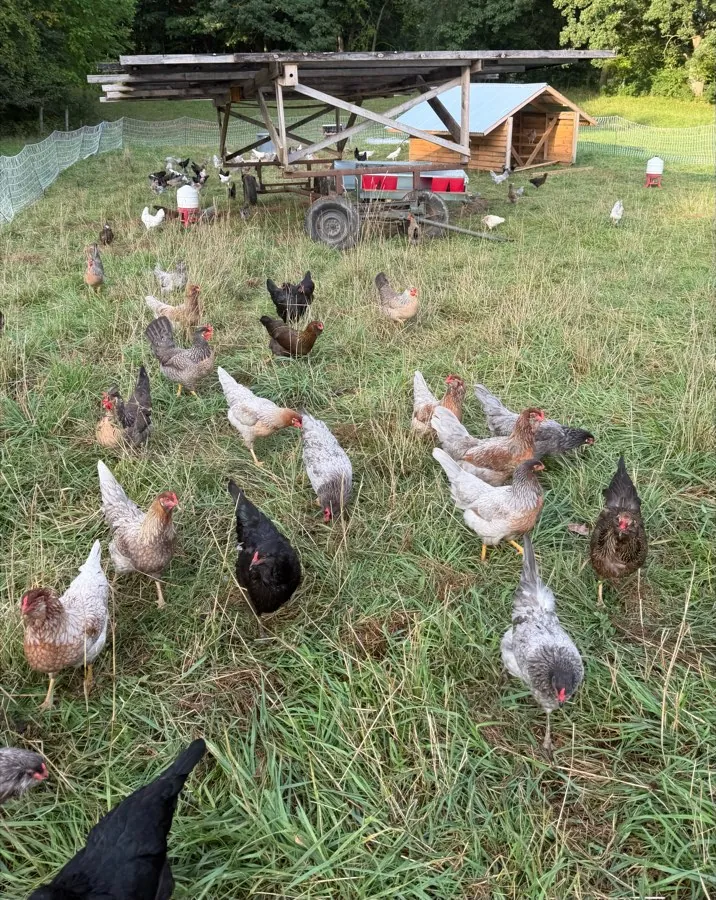
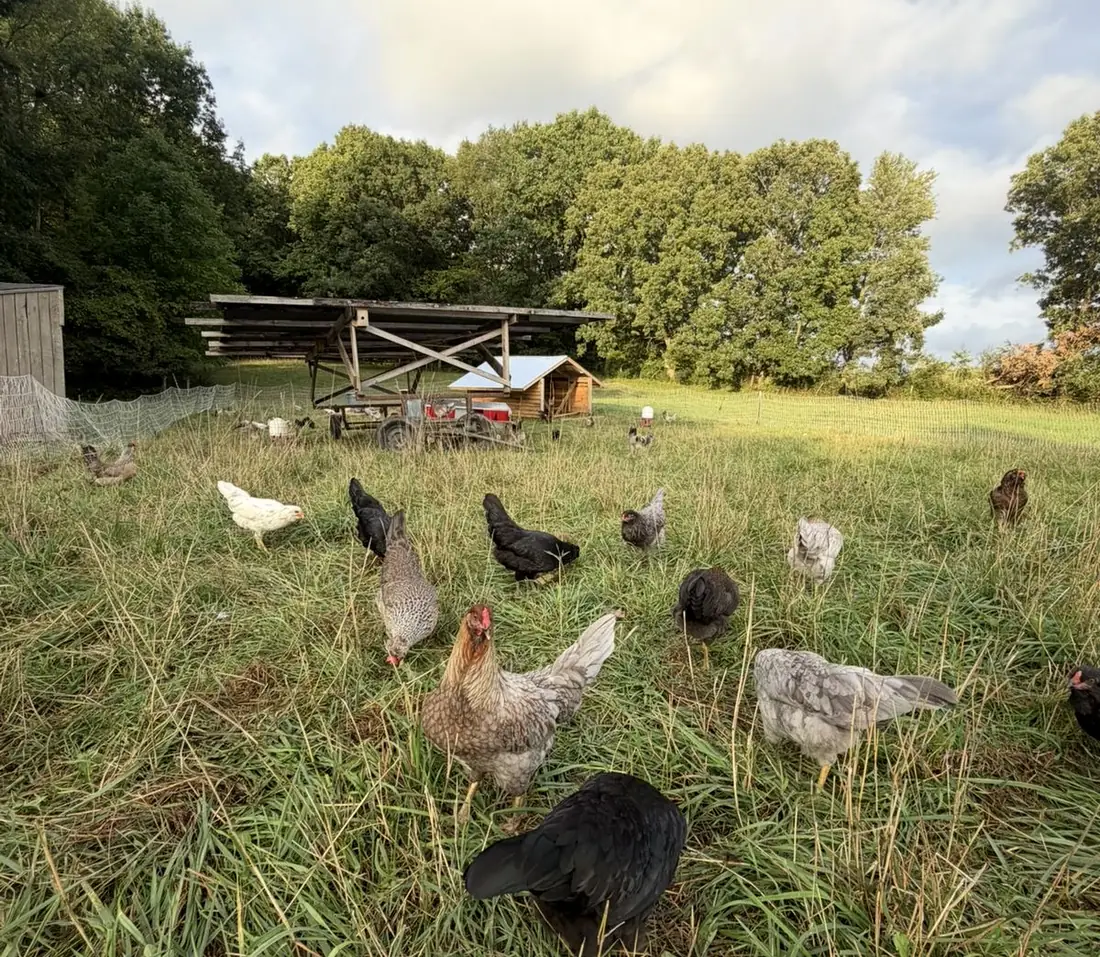
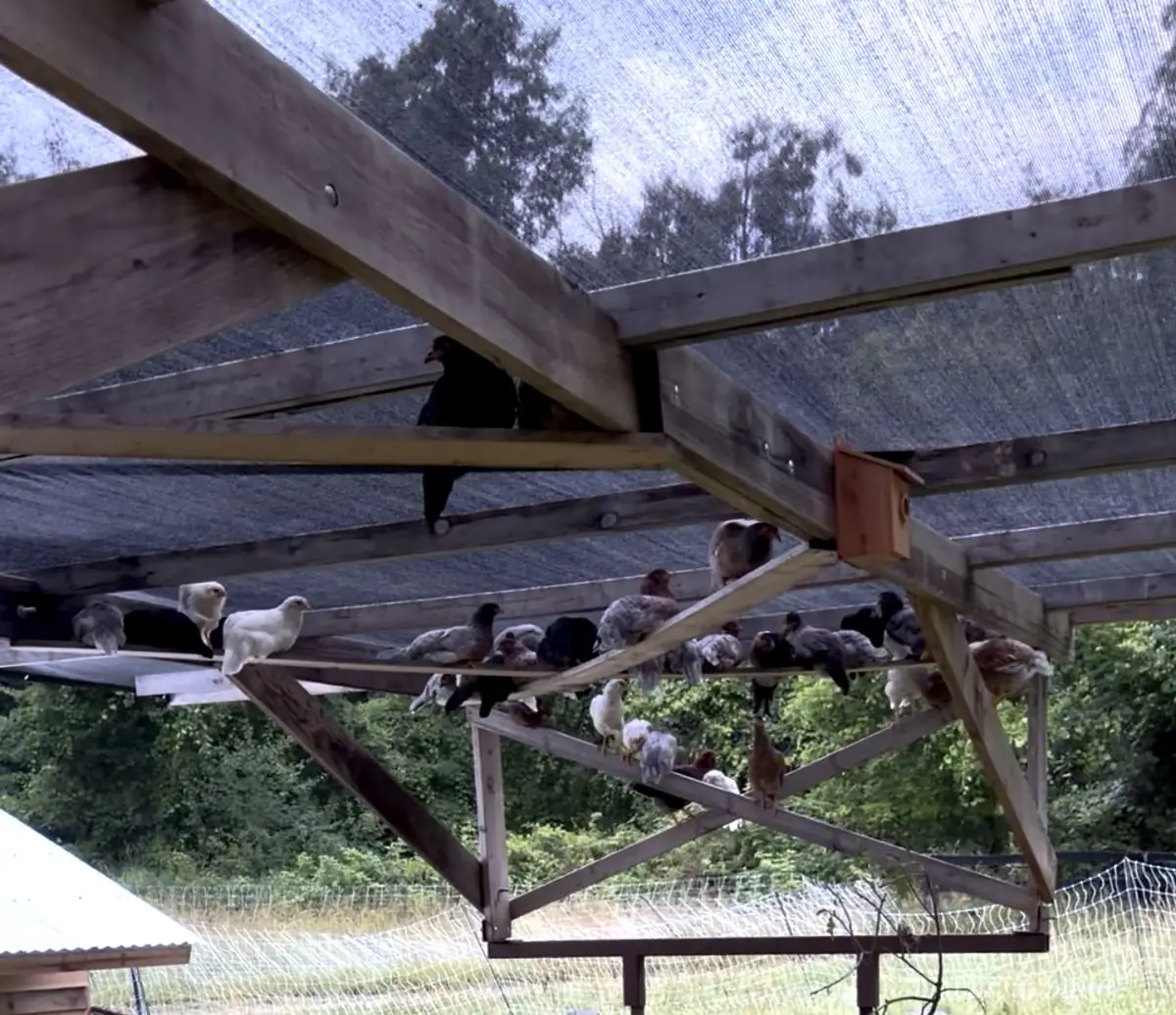
Our hens aren’t parked on one yard. They live inside electric netting with the shade mobile, the eggmobile and the roost, and the whole camp gets picked up and set down on fresh ground again and again through the season — usually across pasture the cattle and sheep have already grazed. Inside the fence they do as they please; it’s the fence that keeps moving. They earn their keep as they go: scratching manure apart, eating fly larvae before they can hatch, and spreading fertility with every step. Free pest control, a cleaner pasture, and better ground for the next graze. Right now the whole camp is on one field the cattle and sheep have already been over twice — the hens are in there to break up the thatch and put fresh fertility back into tired ground.
We move the fence. They walk onto new grass and act like they found it themselves. We let them have that.
Picked up and set down on fresh range — times so far this season — netting, shade mobile, eggmobile and all.
Where they’ve ranged
What they eat
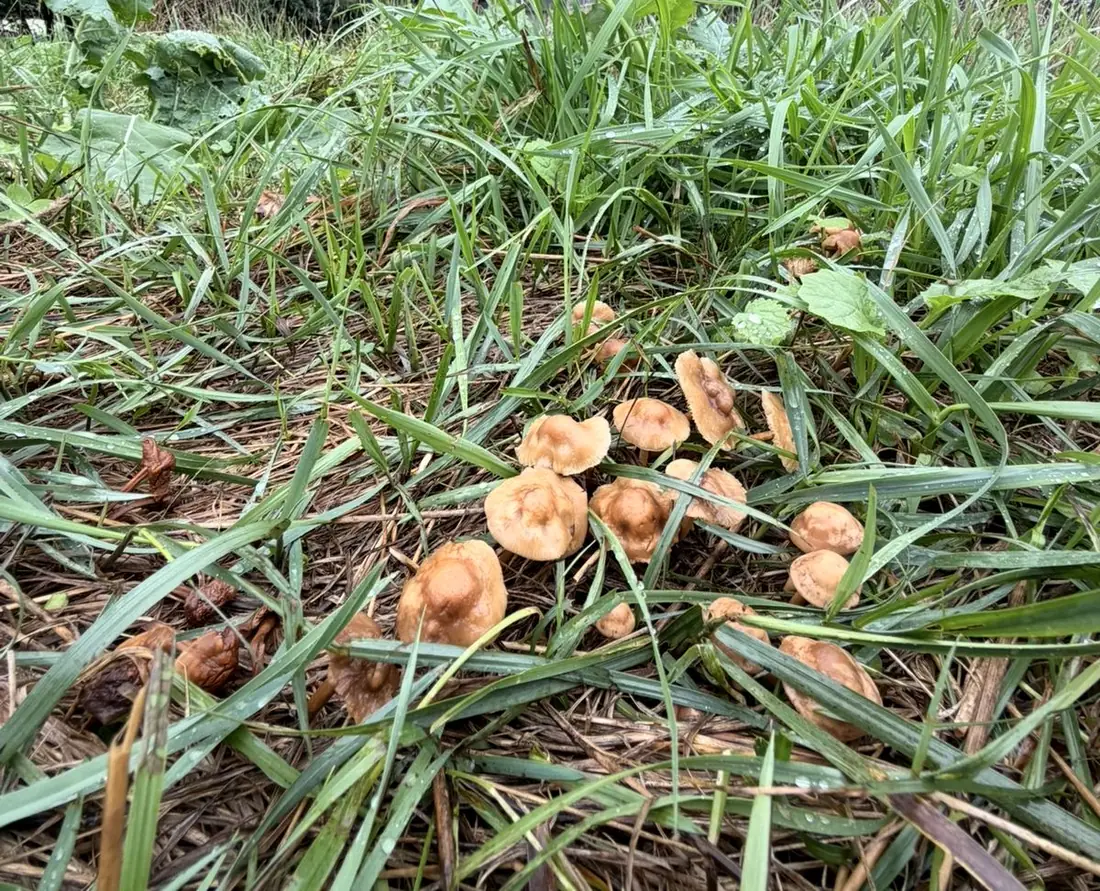
All day they forage — bugs, seeds, greens, whatever the fresh ground offers. It’s the job chickens were built for. And here is the honest share: pasture gives a laying hen somewhere between a twentieth and a fifth of what she eats. A hen isn’t a cow. The rest is a real ration and supplemental calcium, and anyone who tells you the grass does it all is selling something.
Deep colour is the thing everyone looks for, which is exactly why it’s for sale — marigold extract and paprika go into feed specifically to hit a number on an industry colour fan. Ours comes from what they find. Same colour, different reason, and no way to tell them apart in the pan. Which is why the rest of this page is a record and not an adjective.
Why the eggs are blue
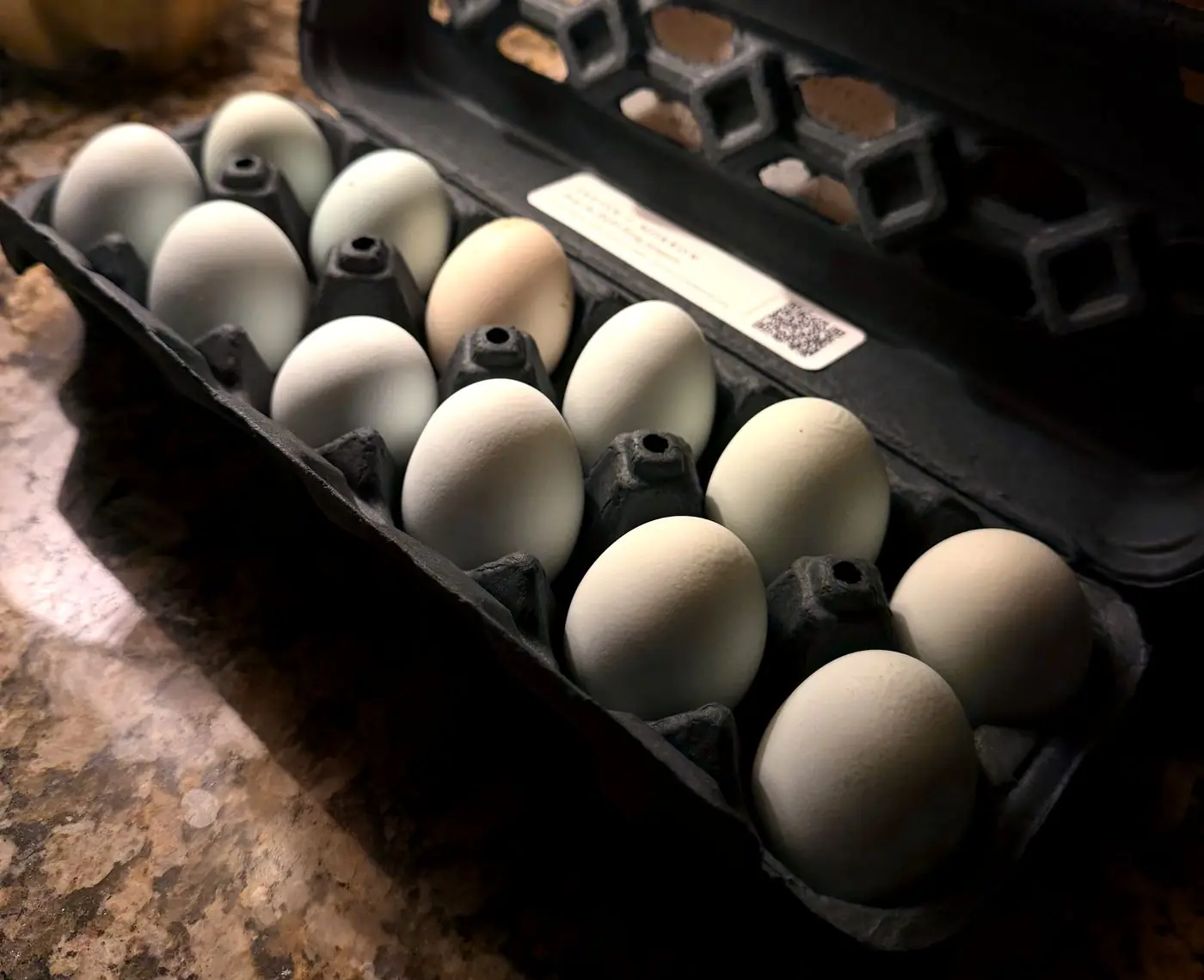
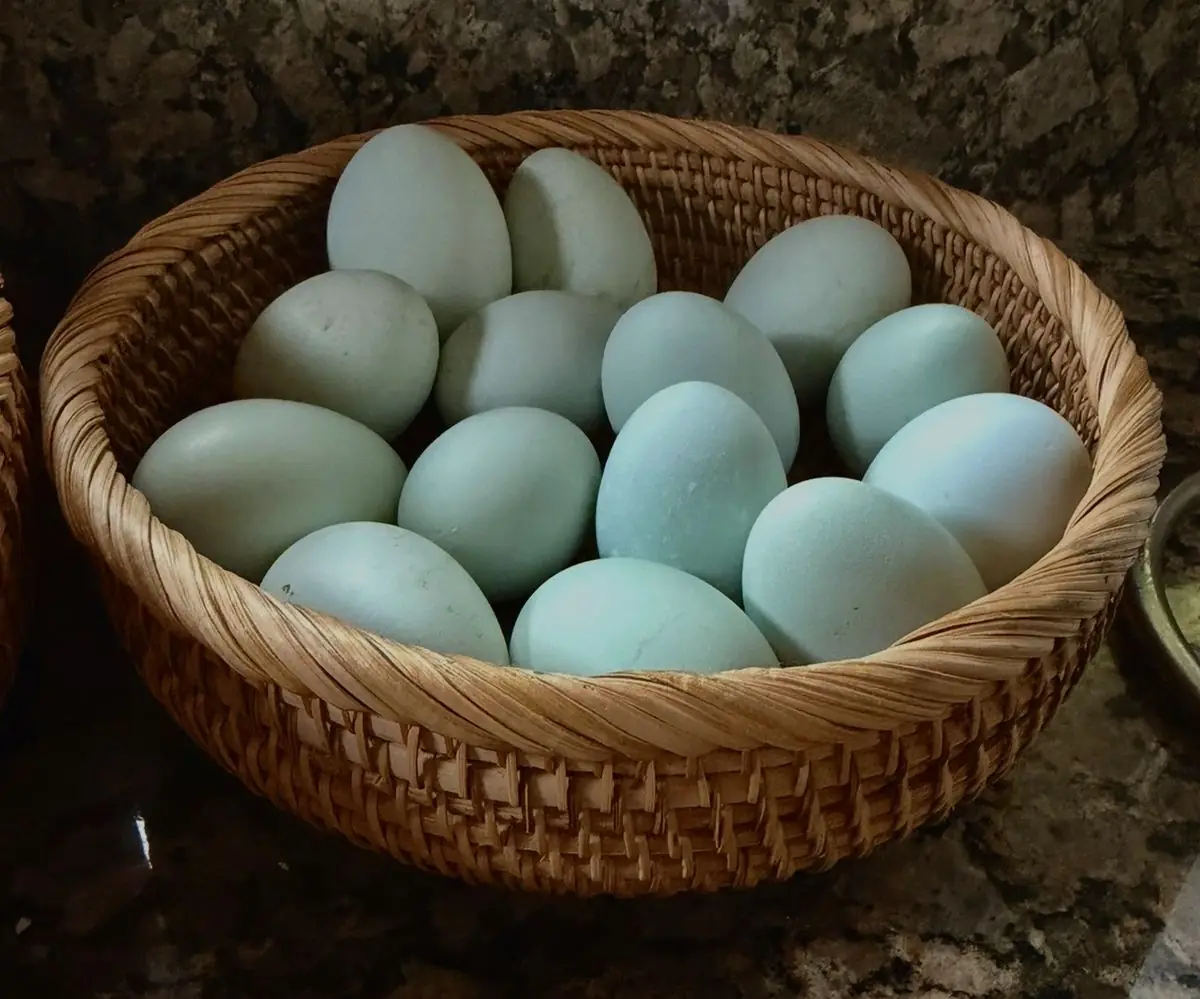
The blue isn’t painted on — the colour goes into the shell as the egg forms. Crack one and the broken edge is blue too. A brown egg is brown on the surface only. Tap one open and look at the rim.
Three of theirs and one from a store. Crack them and look at the edge.
Cream Legbar
An English heritage breed with a punk-rock crest of feathers, and one of the few chickens where you can tell the hens from the roosters the day they hatch. Lays a soft sky-blue egg.
Whiting True Blue
Bred in Colorado by a scientist better known for fly-fishing feathers. Chosen for two things: vivid blue eggs and a real love of foraging.
Blue eggshells were invented twice — once in Chile, once in China, by birds that had never met. Both times the same way: a retrovirus spliced itself into a chicken, and the shells started coming out blue. The prettiest egg in the carton started as a virus. Both breeds above trace back to the Chilean line, so that’s the one in yours.
There’s a cream egg in that carton and it’s one of ours. Blue isn’t perfectly fixed in either line, so every so often a hen lays a plain one. A flock is not a product run.
Why we don’t wash them
Every egg comes out wearing a coat. She builds the entire shell first, then spends her last ninety minutes wrapping it. That wrapping is the bloom — it goes on wet, dries almost at once, and seals thousands of pores you’d never know were there. You can’t see it, you can’t feel it, and it’s the whole reason an egg keeps.
Wash an egg and the coat comes off with the dirt. That’s the refrigerated aisle in one sentence: supermarket eggs are scrubbed before boxing, so the cold takes over a job the hen was doing for free. Ours never see a sink — the seal is still on them when the carton reaches your kitchen.
About two weeks at room temperature — the way much of the world still keeps eggs, and the way every farm kitchen kept them before refrigeration was a thing. Set them out in a bowl and forget about them.
And if a shell wants a rinse: warm water, right before it goes in the pan. Never cold. Cold draws inward; warm carries away.
That’s the whole manual. No ceremony, no special handling — just an egg that still has on it the thing the hen put there.
Every carton leaves here stamped with the day the eggs were picked and packed. That date is where the clock above starts.
Chicken facts, not flock facts
There is no such thing as one curious chicken. There is a chicken, then there are eleven, and then there is a situation.
True of chickens in general — not claims about these particular birds. Everything else on this page comes off the record, and that distinction is the whole point.
Who “we” is
My wife and me, our three kids, and my parents, who help tremendously. That’s the whole crew.
We wanted something creative that also had a job to do. Cream Legbars are autosexing — you can tell the pullets from the cockerels the day they hatch. Whiting True Blues are serious foragers. One day we’d like to hatch the mixed offspring of the two and see how they do out here.
Some of these birds are exceptional fliers and would rather spend the day on the wrong side of the netting. The guardian dogs worked out that this was a game, and we have lost hens to it.
Systems never work as well as they do on paper. Adapting a miss into a win is the part that actually counts.
No memory. No marketing. Just the record.
What a dozen costs
They hatched on 15 March. The first egg turned up on 20 August — five months of feeding a flock that produced nothing at all. That feed is certified organic and soy-free at fifty-two cents a pound, blended at Raub-Rae forty minutes from our gate, and the bill for it doesn’t pause on a slow week.
Seven dollars is what it takes to do it this way.
None of this is written ahead of time. When the flock moves, this page redraws itself — new ground on the map, a new count on the eggs.
Come winter the whole flock moves into a hoophouse on deep litter — the bedding composts underneath them and warms the building from below — with some added light to hold them on a normal day length and keep them laying.
Come back and see where they end up.
The flock lives at The Wildwoods Farm in Hadley Township, Michigan: cattle, sheep, and laying hens on 50 acres of healing ground. Weekly egg shares are open now, and a passport like this stands behind every carton.
See the egg shares →